5 must-dos for SEO Beginners

5 must-dos for SEO Beginners

You might disagree, but I see Search Engine Optimization as both an art and a science. You need to be creative in your approaches to please search engines and outsmart competitors while also applying solid research and analytics-based strategies.
To do this, you need to employ a variety of techniques and tools. Unfortunately, however, most people tend to stick to what they know. That can be dangerous in the rapidly evolving SEO space, as the search engines continually adjust what they’re looking for and how they display results.
Following, some of the significant — but sometimes forgotten — levers you can pull to enhance your SEO efficiency

Keyword grouping

Keyword grouping refers to the organization of keywords into clusters for a variety of purposes — to inform your site’s information architecture, to optimize landing pages, to identify potential areas of content development opportunity and more.
But organizing your search keywords into the most valuable groups can be a difficult task, even for a seasoned guru. While different SEOs and tools take a variety of approaches, I find it best to unite keywords into clusters based upon whether queries using them results in similar URLs appearing in the top 10 results in Google.
If you have many landing pages to work with, it can be a weighty task to make reports, optimize and manage your SEO projects. As the keyword landscape is always changing, you need a tool and a solid strategy to cope with the challenges.
Benefits of keyword grouping
  • A keyword grouping strategy allows you improve your SEO and PPC workflow and get a better understanding of how each type of a keyword is working for you.
  • It helps with on-page SEO optimization, copywriting, topic selection and organizing your website architecture.
  • You can prioritize your landing page creation based on what seem to be the most promising keyword groups.
Many webmasters use Excel or AdWords Editor to group big collections of keywords into smaller and more targeted lists, but it’s easy to make mistakes when working manually with large volumes of data. Using special tools for keyword grouping — such as SE Ranking Keyword Grouper or Wordstream Keyword Grouper — speeds up the process tremendously while maintaining quality and efficiency. Of course, no tool is perfect. It still takes a careful eye and some spreadsheet skills to make the groups perfect.


5 must-dos for SEO Beginners

Page change monitoring

Monitoring page changes is a new tactic for me, but I find it’s absolutely crucial to SEO. With page change monitoring tools, you can receive alerts about any changes on the pages you are optimizing. If you’re a small business owner who is the only one touching your pages, this tip isn’t for you. But it will be invaluable for those who work within large marketing teams and agencies on projects where the website is accessed by many webmasters, marketing experts or clients.
When you monitor pages, you will always know when your client or a webmaster make a website change that will impact your rankings — and you’ll be able to make any necessary adjustments before your rankings drop or you get penalized by Google. We all know that even minor changes can have serious consequences, so it is really important to be aware of any adjustments before the pages are indexed by search engines.
You can use a variety of tools and apps to set up alerts for any page changes. These include VisualPing and ChangeDetection.com.
SE Ranking’s Page Change Monitoring also allows SEO experts to set a scan frequency and track and analyze the changes that occur between each scan. If your website is getting hacked, the feature will detect and show malicious code and bad links as well. You can monitor any pages — yours, clients’ or competitors’.

5 must-dos for SEO Beginners

Competitor SEO research

Staying smart on the competitive landscape is critical for SEOs and marketers. Inform yourself by keeping track of your competitors’ marketing activities, starting from search rankings down to new content and links.
Lots of tools can help you discover competitors’ keywords for organic search. SpyFu, SEMrush, BuzzSumo and Ahrefs are some of my favorites.
As I mentioned briefly above, one often-overlooked tactic is to use a monitoring tool to spy on the changes (like new links or new content) competitors are making on their sites. This will allow you to discover what they are doing to generate quality traffic and let you develop your own outsmarting strategies based on those findings.

5 must-dos for SEO Beginners

Long-tail keyword variations

Embracing long-tail keywords is vital for online businesses that want to get high rankings in organic Google searches. Long-tail keywords are often neglected because they initially get less traffic, but by cultivating those who search for these terms, you will get better results in the long run. That’s because these searchers — with their very specific lower-funnel queries — are exactly the target audience you are seeking.
The challenge is to find profitable and useful long-tail keyword variations for your niche and your website. Luckily, a lot of keyword suggestion tools provide this feature for use in optimizing your pages. Some of the more well-known include Google’s Keyword Planner (in AdWords) and WordStream’s free keyword tool.
 
Mobile rank tracking 
 
It’s impossible to ignore the incredible impact mobile devices are having in everyone’s daily lives, so mobile metrics are growing increasingly important.
Though Google hasn’t yet fully rolled out its mobile-first index, it’s on the way. And the mobile-friendly algorithm is already in play. For these reasons, you’ll want to keep a close eye on your mobile rankings, and any mobile fluctuations and changes, as they occur.
Using Google Search Console, you can check mobile rankings using the Search Analytics report. There, you can compare desktop and mobile rankings, looking at time frames, impressions and clicks for mobile rankings.  

5 must-dos for SEO Beginners

Comparing desktop and mobile ranking will allow you to quickly identify problems posed by the mobile-first index rollout. If a page is ranking significantly lower in mobile, look closely at the factors that might be less than mobile-friendly.
There are also a variety of SEO platforms (too many to name) that provide info on mobile ranking, so consider utilizing these when optimizing for mobile search. You can import the results from multiple tools, including Google Search Console, into a keyword rankings dashboard to centralize your information in one place.  

Local keyword ranking

If your products or services are of interest to folks in your geographical area, make sure you’re also optimizing for local searches. As people carry around their smartphones and perform searches while out and about, local search — like mobile — is becoming increasingly important.
A challenge here is that proximity has been identified as a key factor in local search rankings, which means that different people in different places will receive different results for the same queries. Therefore, you need to employ tools that are designed especially to take on this task.
Some possibilities include SERPs’ Keyword Rank Checker (which lets you input local parameters) and BrightLocal’s free localized ranking tool.

Conclusion

SEO is a dynamic marketing field, which makes it both challenging and exciting. The good news is that you can gain a competitive advantage if you keep up with the latest tools and techniques, such as the ones I’ve detailed here.

Unconfirmed Google algorithm update may be better at discounting links and spam

Unconfirmed Google algorithm update may be better at discounting links and spam

Google may have made some tweaks to their algorithms this week on how they target link spam and other forms of spam. Google would not confirm or deny there was an algorithm change, but based on the signals I am tracking, there appears to have been an algorithm update that has hit those who undergo more aggressive link building.

The update seems to have happened around February 1, 2017. It may have been a tweak to how Google Penguin detects and discounts spammy links, or it may be a totally new algorithm — we are unsure. But many of the folks within the “black hat” SEO community seem to be noticing this and complaining that their tactics are not working as well.

Some are saying that their PBNs, private blog networks, are not working as well. Some are saying Google is slower at picking up new links. Some think Google hit their sites with penalties.
The vast majority of the Google search results tracking tools, such as MozCast, Algoroo, RankRanger and many others, are showing significant turbulence around February 1.
This is all despite many of the more “white hat” SEO communities not really noticing or complaining about ranking changes in Google.

If we had to guess, I’d say this is an algorithm update around how Google discredits spammy links, maybe updating the Penguin algorithm or something else.

We should note that Google did launch an algorithm update specifically for Google Japan and Japanese content this morning, but that is unrelated to this link update.

The impact (and lack thereof) of Google’s mobile popup algorithm

The impact (and lack thereof) of Google’s mobile popup algorithm

It’s not often that Google announces an algorithm update in advance. But when they do, not only can webmasters prepare for that update, we can also track its rollout once Google pulls the trigger. That provides a rare opportunity to gauge the impact of the algorithm update and determine what its effects are.
That’s exactly what I’ve been doing since January 10, 2017.
In August of 2016, Google announced that they would be rolling out an update on January 10, 2017, that could impact URLs employing intrusive mobile popups or interstitials. For example, if a URL presented an interstitial that covered a substantial part of the content, then that URL could be demoted in the mobile search results. The web as a whole cheered, as many users were extremely frustrated by aggressive mobile popups.
So, as January approached, many SEOs, webmasters and business owners wondered what the actual impact would be. Would there be mass casualties, minor bumps in the algorithmic road or something in between? Based on Google’s announcement, you would think that sites employing intrusive popups or interstitials would have gotten smoked by the algorithm. That would make sense, but when you’re dealing in an algorithmic world, the devil is in the details.

Preparing for the mobile popup algorithm

As the rollout neared, I had many questions. Would the update actually work? How extreme would it be? Would there be loopholes? How would it impact branded versus non-branded queries? Would large-scale sites be impacted as much as smaller sites? And so on and so forth.
That’s why I prepared for the update by collecting as many sites using mobile popups or interstitials as possible. My goal was to benchmark those sites and then gauge the impact as the mobile popup algorithm rolled out. I’m now tracking close to 70 domains on my mobile popup list — and those sites are across verticals, including news publishers, entertainment, sports, e-commerce retailers, bloggers, music and more.
Starting on January 10, I began checking my list twice per day to see which sites were still breaking the rules and which ones weren’t. And for the ones breaking the new Google mobile popup law, how much negative impact would they see? Would they see any impact at all?

My travels along the popup algorithm trail

My research took me across many sites, both large and small, across many categories and locations. It was fascinating to see which sites raised the white flag and stopped using popups or interstitials and which ones stood their ground and kept them. It was also eye-opening to analyze the various ways websites employed popups and interstitials in this new world (if they kept them). It was enlightening, to say the least.
And of course, I was able to see many different types of ads and interstitials, including benign newsletter signups, aggressive ads that take over your screen, autoplay video in popups, broken ads in popups, and even malware and malicious downloads from ads in popups. There were times I felt like I needed battle armor while visiting some sites.

The impact (and lack thereof) of Google’s mobile popup algorithm

Below, I’ll cover the impact, the non-impact, the natural side effects of a preannounced Google algorithm update, examples of popups and interstitials, and other interesting notes. So join me on a ride through mobile popup land.

January 10, 2017: The rollout begins

When the rollout began, I was excited to check my list and determine if there was any impact. As you can guess, there wasn’t much to report on the first day. The algorithm had to fully roll out, so I began checking my list twice per day to gauge the impact. And as I was checking the mobile SERPs, I ended up finding even more sites using mobile popups and interstitials. So my list was naturally growing as time went on.
On January 12, I noticed what I believed were the first signs of impact, and I wrote a post to document my findings. My plan was to keep adding findings to that post as I came across more and more impact.
Well, that didn’t turn out very well. After some initial movement, there seemed to be very little impact (if any at all).
I kept updating my post with disclaimers about the lack of impact I was seeing. I was floored. I thought for sure the domains I was tracking would see some movement, but I was wrong. I checked twice per day, only to see many of the URLs from those domains ranking exactly where they did prior to the rollout.
As of today, I’m still not seeing widespread impact. Again, many of the URLs across the domains I’m tracking are ranking exactly where they did prior to the rollout of the mobile popup algorithm. Therefore, I’m officially calling the mobile popup algorithm a dud. Sure, that can change if Google strengthens the algorithm or refines it, but for now, it’s not doing very much.

The impact (and lack thereof) of Google’s mobile popup algorithm
Examples of popups and interstitials still in use

You might be wondering what I’m seeing when checking sites. Well, I’ve seen it all since January 10: newsletter signups, popups on scroll, delayed popups, multi-ad interstitials, autoplay video, broken popups, malware, malicious downloads, multiple popups on one page, and so on.
Without revealing the sites, here is a potpourri of popups and interstitials I have come across during my travels. These are all from URLs that currently rank highly for competitive keywords — and ranked there before the algorithm update rolled out. Also, the desktop and mobile rankings are equivalent. In other words, I’m not seeing a drop in the mobile SERPs when compared to desktop, which would happen if the mobile popup algorithm were impacting rankings.
I’ll see you on the other side. That’s where I’ll cover the true impact of the mobile popup algorithm — and it might not be what you’re thinking.
 The impact (and lack thereof) of Google’s mobile popup algorithm

 The impact (and lack thereof) of Google’s mobile popup algorithm

And many more…

The true impact of the mobile popup algorithm

Well, the true impact has nothing to do with mobile rankings being impacted, a slide in mobile traffic or anything related to SEO. Instead, it has everything to do with the reaction of publishers to the news that the algorithm was going to roll out.

For example, many publishers removed mobile popups and interstitials as January 10, 2017, approached. They simply didn’t want to get hit or test the algorithmic waters. I saw this a lot as I was collecting sites that were employing mobile popups.

This also included sites removing the popups after January 10. Not every company knew about the algorithm update, so some were late to the game. My guess is that the algorithm got on their radar based on news of the rollout, so those publishers had a knee-jerk reaction and simply removed their popups without gauging the actual impact. They basically trusted that the mobile popup algorithm was working without evidence of it actually working.

And I get that. If you’re not neck-deep in SEO, you might not be familiar with the gray area of algorithms, and you might not know that some algorithm updates simply don’t work as expected. For those people, they just knew it was rolling out, that it could potentially negatively impact their rankings and traffic, and they pulled the popups and interstitials from their sites.
But like I said earlier, the devil is in the details. Again, I’m not seeing any widespread impact from the mobile popup algorithm as I write this post.

High risk, high reward: Will Google turn up the dial?

And here’s the rub. The publishers I mentioned earlier that stood their ground and refused to remove their mobile popups and interstitials have braved the mighty tsunami that never arrived. They stood on the beach facing a powerful surge of water that would surely suck the mobile life out of their sites… and nothing happened.

But that’s for now.
Google can absolutely turn up the dial and strengthen the mobile popup algorithm at any time. And if they do, then those sites using mobile popups or interstitials could get smoked. But that’s a big could.
Now, I’m not saying mobile popups are a good thing. I actually can’t stand most of them, and users overall hate them. That should be enough to rid them from the web, but they do work conversion-wise (unfortunately).

So, we have a situation where an algorithm that should impact URLs employing mobile popups is not living up to expectations, and a marketing tactic that drives conversion was removed from many sites. I don’t know where we go from here, but I fear more sites will test the algorithmic waters and add those popups back. And it’s hard to blame them.
So, based on what I explained in this post, I’ll provide some closing points below.

Key points
  • Although there hasn’t been widespread impact yet, Google can turn up the dial at any time. I know many people are still hoping that happens; and if it does, sites using mobile popups or interstitials can get hit. Remember, high risk, high reward.
  • Publishers are still figuring out ways to push the envelope with mobile popups in order to determine which formats and techniques will get hit and which ones won’t. But based on my research, there’s very little negative impact overall so far. I recommend watching my initial post for more updates.
  • Never simply take Google’s word for it. Track and test updates for yourself. I’m glad I decided to gather close to 70 sites using mobile popups and interstitials. That enabled me to test how strong the algorithm was and if it was doing what it was supposed to do.
  • Mobile popups and interstitials are horrible user experience-wise, but they perform well conversion-wise. Based on the lack of impact from the mobile popup algorithm, I fear we will see more sites testing the waters and adding them back. It pains me to say that… but the lack of impact is clear.
Summary: The waiting continues
When January 10 arrived, I was eager to gauge the impact of the mobile popup algorithm. But what I wasn’t prepared for was to see very little happen. And that’s exactly what occurred while checking many sites still using mobile popups and interstitials.
Moving forward, keep an eye on my Twitter feed and my original findings post. I will keep checking my list, and checking it twice, in order to see if the mobile popup algorithm is being naughty or nice.

The PPC industry would not exist under Trump’s immigration policy

The PPC industry would not exist under Trump’s immigration policy

President Donald Trump’s executive order barring people from seven predominantly Muslim countries from entering the United States, even if they have a valid visa or green card, is not the way to “make America great again.” In fact, the online marketing industry as we know it would not exist had this order been in effect in Google’s early days.
Let me explain.

One of the most successful companies to come out of the US in the past two decades is Google, founded by Sergey Brin, a Russian and Larry Page, an American. While they had a great search engine, there was no business model. According to John Battelle in “The Search,” Google was months away from shutting down in 1999, when it was spending $500,000 per month with only $20 million in the bank and no significant revenues of any kind.

Employee #9, Salar Kamangar, born in Tehran, Iran, is credited with figuring out how to start making money by selling relevant ads on Google.* Employee #11, Omid Kordestani, also born in Tehran, figured out how to scale that business.

How much did it scale? In 2016, Google parent Alphabet Inc. and Apple went back and forth for holding the honors of being the world’s most valuable company based on market cap. On January 26, 2017, Google, the part of the business including ads, reported Q4 2016 revenues of $25.8 billion with profits of $7.8 billion. It is estimated that about 90 percent of Alphabet’s revenue comes from ads.

Had it not been for two Iranian immigrants and all the profits Google makes from selling ads, Google might no longer exist today. When I worked there from 2002–2012, I found ads tremendously exciting, but I also knew that my work helped fund all the things that make our lives more convenient and that we could not imagine being without, like Maps, Search, Gmail, Apps, and soon, self-driving cars.

And the benefits haven’t been limited to making life more convenient or giving all of us in the online marketing industry our careers and livelihoods. It’s benefited companies of all sizes everywhere. Across the US, Google’s search and advertising tools helped 1.4 million businesses drive $165 billion in economic activity in 2015.

And that is why I will argue that President Trump’s latest executive order is misguided.

Disclaimer: The views and opinions expressed in this post are my personal ones.
*The pay-per-click advertising model was invented by Bill Gross of Idealab. Salar’s unique twist was to make ad relevance part of the ranking algorithm. Online ads at the time were on the decline because users hated how irrelevant and interruptive they were. By making them relevant, users started to click on ads to connect with companies that could help them, a true win-win.

AdWords IF functions roll out for ad customization as Standard Text Ads sunset

AdWords IF functions roll out for ad customization as Standard Text Ads sunset

First, a moment of silence for the Standard Text Ad format that held on for 15+ years. Today marks the end. And with that, Google is rolling out AdWords IF functions globally to give advertisers the ability to customize their ads in much the same way ad customizers allow, but without the feed.

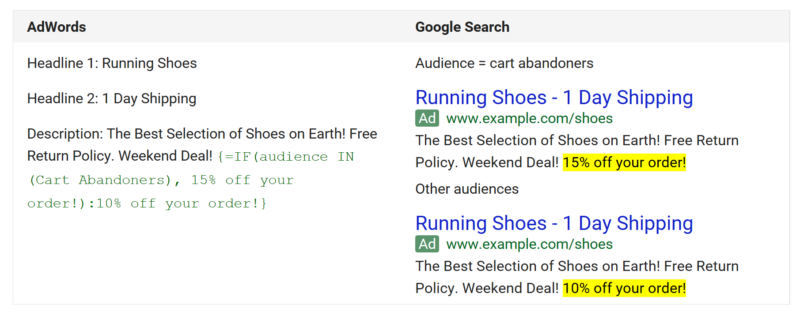
With IF functions, text ads can be tailored based on whether users are on mobile and/or are members of an audience list. For example, Frederick Vallaeys wrote in his column about using the IF function for mobile last fall, when the feature was first announced, as a way for advertisers who were running mobile-preferred Standard Text Ads to continue customizing ads for mobile users.

In the example below from Google, an If function is used to customize the description offer based on whether a user is in the advertiser’s “Cart Abandoners” retargeting list. If they on the list, users will see a “15% off” promotion; if not, they’ll get a “10% off” offer.

AdWords IF functions roll out for ad customization as Standard Text Ads sunset
Syntax
Broken down, the syntax for IF functions is:
  1. Start with “{=IF”
  2. Add an open “(” after IF
  3. Follow with the targeting of “device=mobile” or “audience IN”
    1. If you’re using audience targeting, put the list you want to target inside parentheses. If you are targeting multiple audience lists, separate them with a comma.
  4. Put a comma after the targeting.
  5. Add the text to insert when targeting criteria is met.
  6. Close “)”
  7. Follow with a colon “:”
  8. After the colon, add the default text that will be used when the targeting criteria is not met.
  9. End with the closing curly bracket “}”
Put together it looks like this:
{=IF(device=mobile or audience IN(audiencelist1,audiencelist2), Custom Text): Default Text}

A few more things to note

If you’re creating ads in the web UI, the IF function option will become available when you enter a curly bracket “{“. However, for now at least, it defaults to the mobile targeting syntax: {=IF(device=mobile,insert text):default text}. You’ll have to change it for audience targeting, and be sure to use the exact list name.

IF functions can be used anywhere in an Expanded Text Ad except for the final URL. They are only eligible to run on the Search Network.
And last but not least, with the default text provided with IF functions, advertisers don’t have to have an ad that doesn’t use customizers in their ad groups.

Google launches Ads Added by AdWords pilot: What we know so far

Google launches Ads Added by AdWords pilot: What we know so far

Automation is nothing new in AdWords, but this month, Google launched a pilot that adds new text ads to advertisers’ accounts. Dubbed Ads Added by AdWords, the program started on January 26.
Not surprisingly, this news has set off alarm bells among paid search managers that worry about Google usurping control over the ad creation and testing process. Here is what we know so far about this test.
The initial set of advertisers were notified of the pilot on January 12. For those that chose to participate, ads were added to ad groups two weeks later, on January 26, at which time a second wave of advertisers were notified about the pilot. Currently, 2,000 accounts have been selected for the test. Each has a two-week opt-out window via a form. If you do not receive an email, you haven’t been selected for the pilot.

What accounts were considered for this program? Google looked at campaigns with ad rotation settings of either “Optimize for clicks” or “Optimize for conversions” that have ad groups with few ads in them.

If you’ve opted out of automated extensions or are in a vertical with privacy sensitivities such as pharma, your account was not selected for this program.

How are the ads generated? We’re told that for the test, the ads were generated by people (as opposed to auto-generated) based on the existing ads in the account and the landing page content. The ads went through review by the product team, among others, for quality assurance. The sales teams were also involved in creative review and account selection for the pilot.

From the Help Center page on this new program, we also know that any ads generated for the pilot will be labeled “Added by AdWords.” In the example below (yes, all of the ads are terrible, but try to look past that for now), Google has added two test ads in an ad group that had just one ad. Notice that the headlines, description and paths are all being tested.

Google launches Ads Added by AdWords pilot: What we know so far

Google says on that Help Center page, “We believe that adding more ads to the affected ad groups can improve these ad groups’ performance by 5 to 15%.” The new ads are set to run indefinitely, and Google recommends pilot participants not pause the ads. Theoretically, if they perform worse (based on conversion or click-through rates), the ads will be shown less. But certainly, review the ads if you’re participating in the test, as Google also advises.

This program obviously raises more questions about advertiser control and the role of machine learning in ad creation. If Google deems the pilot successful and rolls out Ads Added by AdWords more broadly, it’s hard to see how the current ad creation and vetting process can scale without automation. One can assume that the machines will be learning from this pilot.

If you think you might miss the notification email from Google about this test, Frederick Vallaeys has written a script for MCC accounts will send an email if it finds automatic ads: https://gist.github.com/siliconvallaeys/a42e247d7923a3181b0a9eb7332fdbad

New AdWords interface alpha is rolling out to more advertisers

New AdWords interface alpha is rolling out to more advertisers

Google has been slowly building out the new AdWords interface, which was introduced last March. More accounts have been granted alpha access, and on Tuesday, Google’s head of search ads, Jerry Dischler, said it is rolling out to even more AdWords accounts in the next few months.
When you first get access, you may be taken right to the new interface, or you may see a notification in the top right corner or at the bottom of the screen like the one below.

New AdWords interface alpha is rolling out to more advertisers

Don’t worry about clicking it and never being able to get back to the land you know. You can toggle back and forth between the new and old interfaces, which you’ll want to do because functionality like being able to download data is still not available. A guided tour will launch the first time the new UI loads in an account.

Last fall, I wrote about some of the handy, time-saving visualizations in the new interface, which you might find helpful if you’re just  getting access or want to see what’s coming.
Google continues to add more features to the new UI, so even if you don’t find yourself working in it extensively at first, it’s worth continuing to check out and get used to the navigation. Here’s a look at an Overview screen today. The Advanced bid adjustment menu option on the left nav is relatively new, for example.

New AdWords interface alpha is rolling out to more advertisers

Google says accounts are selected based on a number of factors, such as the features used.

How artificial intelligence drives PPC automation


From the 1970s through today, there have been three waves of technology innovation in the Silicon Valley that have spawned many industries, including ours (online marketing).

Google testing new look for local inventory ads in place of local pack

Google testing new look for local inventory ads in place of local pack

Google appears to be running a limited test for local inventory ads (LIA) on mobile that looks like a shopping ad-ification of the Local Pack.

Spotted on mobile by Mike Blumenthal on a search for “engagement rings Buffalo,” the result shows a map with a couple of LIAs below it where local pack results would typically show. I have been able to replicate the result in the Google mobile app. Here the ads are for two different rings at two different Kohl’s locations in the area, signified by the respective shopping icons on the map above the ads. Clicking on either ad takes the user to the local inventory ad landing page hosted by Google.

Google testing new look for local inventory ads in place of local pack

For comparison, here’s the result I see using Safari on mobile for “engagement rings Rochester” (the same search with “Bufflalo” looked similar). The result shows an all-organic local pack with listings for three independent jewelry stores.

Google testing new look for local inventory ads in place of local pack

When introducing new promoted places ads in Maps last spring, Google noted that local searches are growing 50 percent faster than overall mobile searches. It’s no surprise, then, that Google has been ramping up efforts to monetize all those local mobile searches in the past year. Other efforts have included featuring LIA data in Maps and Knowledge Panels with inventory search capabilities, showing in the Local Finder and including ads in the Local Pack.

Paradigm Shift: Has Google Suspended Defamation Removals?

Paradigm Shift: Has Google Suspended Defamation Removals?

A number of attorneys who specialize in online defamation/libel cases have reported to me that Google has recently suspended its longstanding, informal policy of removing URLs from US search results that are specified in duly executed court orders. This poses a major paradigm shift for many victims of online reputation attacks.
Beginning around August or September of this year, a number of attorneys from across the US began receiving blanket denials after submitting requests to remove defamatory content from Google’s search results.

Since at least 2009, Google has had an informal policy of accepting many removal requests when accompanied by a properly executed court order specifying defamatory/libelous content at specific URLs. I’ve personally seen a number of cases where hundreds and even thousands of URLs have been submitted with court orders, and Google has removed those URLs from search results.
But they’ve now stopped. Not for every single request, but for a sufficient number that it’s clear something has changed.

Background: Search engines immune to libel removal demands

It’s worthwhile to note that search engines, and various other types of online sites and services, were made immune in the United States from liability for things like defamation/libel by Section 230 of the Communications Decency Act (“CDA”). For hundreds of years of established law, publishers (such as of books and newspapers) could be held responsible for content published through them.

With the advent of the internet age, it was initially unclear how some types of websites should be categorized — were they publishers, and should therefore be held directly accountable for defamatory content, or were they merely distributors of others’ content, similar to libraries and bookstores, and should therefore not be considered liable for their content? There were concerns that categorizing all types of sites as publishers would potentially have a depressing effect on innovation and business in the nascent internet.

As the Digital Media Law Project states, in 1996, Congress elected to clarify any ambiguity and to simultaneously provide protection for many types of sites by legally defining them as not being publishers:

No provider or user of an interactive computer service shall be treated as the publisher or speaker of any information provided by another information content provider. “interactive computer service” means any information service, system, or access software provider that provides or enables computer access by multiple users to a computer server.

Most courts have held that through these provisions, Congress granted interactive services of all types, including blogs, forums, and listservs, immunity from tort liability so long as the information is provided by a third party.

Google’s help page for requesting removal of content cites Section 230 of the CDA for US users:

Paradigm Shift: Has Google Suspended Defamation Removals?

Despite this signpost that outright states, “Google does not remove allegedly defamatory material from our search results…”, in practice, Google has long chosen to act upon court orders and removed libel and defamation from the search results (legally speaking, court orders identifying such content makes it no longer “allegedly”).
For victims damaged by false statements online, Google’s de facto policy of removing defamation from their results has been a godsend.

Google alters its policy around defamation removal requests

I spoke with multiple attorneys specializing in online defamation across the country, and they all report similar responses from Google recently where the company declined to act on requests to remove URLs listed in court orders. The responses for these included a brief statement reading:

“At this time, Google has decided not to take action.”

It’s not unusual for Google to sometimes push back on such requests in instances where a court order is not specific enough, where the legal work has been sloppy or where URLs are incorrect. But the current denial responses do not appear to be due to those types of protocol mistakes.

Some requests appear to be still undergoing reviews and consideration, and some related to prior removals appear to be still pending consideration. The door to defamation removals may not be completely closed. But some requests are simply being declined with no indication as to why. And they are the sorts of requests that were previously being reliably removed.

Why has Google decided to halt this practice?

We reached out to Google, but they have chosen not to make any official statement at this time. I’ve been informed that Google may still elect to act upon court-ordered libel/defamation removal requests if they choose, on a case-by-case basis. As their help page established, they consider themselves not legally obligated to do so.

For the professionals who assist companies and individuals with legal removals, the lack of explanation around the apparent policy-shift or process-shift is very disturbing, and makes it difficult to convey reasonable expectations to defamation victims. And, in many cases, lack of action on Google’s part will create greater hardship for victims, or will even eliminate any real recourse at all.
The abrupt change in policy has invited a lot of speculation.

I know from multiple past discussions with various search engine company insiders that they consider removals to be undesirably costly, and that materials published on others’ websites are not particularly their responsibility. Quoting what one insider once told me, “This is a project that does not make money for the company, and does not save money for the company, so it is a low priority.”
Electing to not take action on defamation removal requests seems in line with this. They are a business, and should not necessarily be motivated purely out of altruism, according to this line of thinking.
It is undoubtedly costly. Google processes thousands of URL removal requests and maintains staff dedicated to all types of legal removal reviews.

Removal requests may also be philosophically troubling in many instances. According to their Transparency Report, many removal requests citing defamation originate from government agencies and law enforcement. (Albeit, it seems likely that many of these removal requests may originate from countries that do not have as strong freedom-of-speech laws as found in the United States.)

Paradigm Shift: Has Google Suspended Defamation Removals?

Perhaps Google is halting many US defamation removals to make a statement against censorship, here at the tail end of what could be the most rancorous political race in the world’s history.
It’s undoubtedly upsetting for fair-minded employees to be in the position of sometimes removing URLs that critique governments and politicians for countries where it may be deemed illegal to say negative things about officials. But this does not seem to explain what is going on here, since the requests being submitted do not appear to be unfair attempts to censor, but rather malicious and untrue attacks on individuals and companies.
Another explanation could be due to revelations from earlier this year that some unethical attorneys and reputation agencies have abused Google’s removal process and perhaps committed fraudulent actions in the process.

In the spring, Pissed Consumer reported that a number of suspicious lawsuits with purportedly bogus defendants were filed in California courts to obtain defamation court orders enabling URLs to get delisted by Google. In October, Pissed Consumer sued a reputation management company and attorneys that are alleged to be behind “sham lawsuits” and “stooge defendants” that were used to fool Google into removing undesirable consumer reviews.

It seems likely that the revelations around these abuses may have factored into the company’s decision to decline to act on some removal requests. Could it be that Google is now applying some more restrictive requirements around court orders that it will accept in the wake of the unethical manipulation?
Possibly. But, having reviewed some of these requests, I don’t see sloppiness or commonalities with the sorts of things that Pissed Consumer has complained of. If motivated by the abuses alleged by Pissed Consumer, Google could merely be starting to demonstrate that they are autonomous in their decisions about whether or not to remove something.

For the attorneys and their clients who are now failing to procure intervention on the part of Google after they have gone through ofttimes-lengthy and costly litigation processes, the abrupt apparent change in policy and lack of explanation are upsetting and confusing. Is this shift temporary? Should they continue to submit the requests again later? Should they modify the requests in some way? Does Google desire different verbiage in court orders now?

Google is currently silent on the matter. But the statements that Google will not take action may be communicating all that victims may now expect: Your removal requests may be futile.

Should search engines be immune from defamation removal demands?

To a very large degree, search engines have become the internet. If something is not indexed by Google or Bing, or it isn’t searchable and prominent within the search engines, it might as well not exist.
When people are seeking information about a subject, they turn to search engines. So, if the listings on the first page or two of search results contain false, negative and damaging items about a subject, this is where people are often most likely to encounter them. The search engines are the starting point, the gateway to the internet.

Being able to remove results directly from Google largely snaps the connection between the public and the libelous/defamatory content. This option has been the best path for obtaining relief for many victims in terms of comprehensiveness and speed.

Google’s suggestion that one should seek relief by going directly to a webmaster to get the damaging content removed at the source will not work for victims in many cases. If the originating site is also immune under the CDA, then one may not be able to get materials removed, and they will live on in the search results.

Consider Ripoff Report — a site that allows people to post any claims, false or otherwise, about individuals and companies, but does not allow people to subsequently delete what they wrote. Ripoff Report’s policy is to never remove materials, even where one has court orders establishing that content is completely false and defamatory.

Heretofore, one could obtain a court order to present to Google (read the definitive article on the subject, “How To Remove Ripoff Reports From Google — Not Just Bury Them“). Where sites like Ripoff Report are concerned, Google’s willingness to remove URLs with court orders has been the only source of relief available. The Section 230 protections of the CDA have resulted in many similar situations where no one may be legally required to correct or remove misleading and harmful materials.
In yet other cases, websites hosted in foreign jurisdictions may also be beyond the reach of victims based in the US; the internet is a global economy, and without a global solution for false and damaging libel, people simply can become harmed in perpetuity.

Few victims can afford to hire attorneys in other countries where defamation may be hosted, and some other countries may not provide the legal protections established through hundreds of years of tradition and precedent that are found in western countries. (Ironically, a person with dual US/EU citizenship might be able to legally require Google to remove damaging materials from being viewed by searchers within Europe, but not from searchers located within the United States.)

If the only solution available is to take court orders to the websites where defamatory materials are published and persuade them to remove the stuff, then costs increase for victims, as their attorneys or online reputation agencies must go to many sites to remove stuff, rather than to a single source.
I’ve seen multiple cases where defamatory content was spread across hundreds and even thousands of URLs. Instead of communicating with one entity, representatives must go to many, monitor them to see if they comply and follow up when they don’t.

Inevitably, removal of defamatory content will also take longer if Google does not assist. Even if you persuade an originating website to remove something, the listing for it and cached version of the page can live on in Google’s search results for months or even years, continuing to damage one’s reputation. (Professionals may also circle around to ask Google’s automated system to remove the URL due to the page being removed, or one may request the Googlebot to respider the page to update the cached copy to eliminate removed content.)

The human cost

Most people do not feel strongly about online reputation attacks. That is, until their own reputations become impacted by some negative things.
Those of us who work on these sorts of cases are aware that everyone is vulnerable to significant damage from misrepresentation. Many have a notion that they are good people, and therefore do not expect to have their reputations attacked in any way. But it only takes one obsessed customer. One crazy ex-girlfriend/boyfriend. One disgruntled employee.

Once someone libels you on the internet, there’s a very good chance that the materials may find their way up on the first page of search results. Many people make the mistake of thinking that if they avoid having much about themselves on the internet, their reputation and privacy are protected. But privacy and reputation are separate and frequently unrelated entities. So, when something negative gets published into the mix, it can abruptly become prominent.

Your data privacy is maybe intact, but your public reputation can be trashed. Even when one has a strong and established web presence, negative materials can often have an unfair advantage in rankings. Tomorrow, you can wake up and have your reputation ruined.
Online lies can be horrific to endure. They can be so malicious.

Imagine you’re the brilliant doctor who is falsely accused of malpractice. You are the business accused of being a scam and cheating your clients. You’re falsely accused of doing shoddy work. You’re accused of being a Mafia collaborator, a Nazi sympathizer, a pedophile, a nymphomaniac, a rapist or an adulterer. (This isn’t merely melodramatic hyperbole on my part — I’ve worked on cases where people were falsely accused online of each of these things.)

When the lie is the thing that defines your identity, then you lose business, your company fails, and you cannot make new relationships. It can affect everything about your life.

Defamation victims experience deep depression and sometimes consider suicide. Due to the frequency of psychological distress associated with online reputation issues, I interviewed a psychologist, and I refer my reputation clients to them. This stuff takes an extremely heavy toll on people. I’ve had clients who genuinely feared going out to restaurants because they had been accosted by people who had read and believed misrepresentation posted online about them.

In a completely opposite direction last year, Google announced that they would accept removal requests for revenge porn — without even a court order being required. However, a number of porn revenge victims I’ve assisted had instances of defamatory written statements on various web pages in addition to images and videos published to harm them. So, ironically, Google’s current policy shift will make it so that these victims can theoretically get their images taken out of search with just a note to Google, while related defamatory written content might not be removed, even with a court order.

If this new paradigm becomes status quo, the attorneys expert in these matters will likely halt assisting new clients, because there will be no way to reasonably predict positive outcomes, and risk of failure will be too high. If you’re defamed on Ripoff Report, which has over two million reports posted, you’ll be out of luck. Your only recourse in that case may be to change your name, as Google’s Eric Schmidt once infamously suggested. So, defamation victims in the future may find less legal representation available to assist them.

In multiple cases I’ve worked on, reputation attack victims were subjected to extortion. They were threatened that if they did not pay or do something demanded, then an individual would ruin their reputation online by posting falsehoods or private information about them. When they did not pay up, the extortionist followed through, harming them severely.

Here’s an example: “Convicted Search Engine Optimizer Indicted For Retaliating Against Former Victim.” While dramatic, this sort of case where the threat of online damage is used to extort people is not all that uncommon. In another example, one of Google’s own employees was arrested and convicted for attempting reputation extortion to compel women to send him nude photos.

By revoking recourse to have defamatory listings removed, Google will be effectively enabling more criminally minded people to use the search engine’s inflexibility as part of their extortion schemes. Google’s policy change is exposing the large legal loophole created by the CDA: One may launch terrifically damaging materials, and those can rocket up in visibility and never be removed.
Companies threatened by this may decide to simply pay up, rather than risk having to shutter, go bankrupt or lay off employees. It’s satisfying to have extortionists arrested and convicted, but from a business point of view, it’s a losing proposition if you can’t undo the evil damage that has torpedoed your company.

There’s always the “Eric Schmidt solution”: change your name. But changing one’s name to side-step online reputation damage is very costly, too — in terms of money and/or emotional currency.
If you’ve witnessed the costs for a company with a well-established brand name to change that name, you’ll know that this can be extensive and risky — replacing all signs, logos on letterheads, business cards, products, websites — all while losing the equity and recognition built in the name. I’ve also had a porn revenge victim that elected to change their name; it’s not an easy process, fraught with all sorts of issues you can’t foresee, and very difficult to explain to all who have known you by your original name.
Even when you go through a business name change, the loss of identity can sink your company. As I described in “When Brand Names Are Destroyed By Damaging Doppelgangers,” some companies don’t survive this process, since it’s like starting all over with an unknown name.
So, there’s nothing simple about a name-change, and one may not have the necessary amount of money on hand to even make that work.

Is Google liable? Or could the immunity of the CDA be revoked?

I’ve long thought that Google chose to act upon defamation removal requests out of a desire for self-preservation. I thought it was a calculated strategy both to avoid risks of legislature removing some of the immunity provided by Section 230 of the CDA and to reduce lawsuits that they might have to face from desperate people. The immunity provided by the CDA is a huge value to Google, and processing of defamatory removal requests is a relatively small price to pay.

It’s possible for the legislature to modify the Section 230 protection. As I described above, it has enabled situations where horribly damaging false content can be published, and there’s no effective way to help the victims.

It’s possible for legislators to wake up to this and to try to address the lacuna in the current laws. I think all it might take would be a handful of defamed children of congressmen and senators, and legislators might become very motivated to take action.
There is also the fact that the largest search engines are quite different in nature than smaller forum operators, and even the social media services. The search engines are not the equivalent of small libraries or booksellers (which are considered “distributors” and therefore not responsible for the content they have under offline defamation assessments); they are frequently the doorway of the internet.

And the search engines are large enough to be able to afford the costs and the scale of evaluating removal requests. Demonstrably, Google has been absorbing these costs for the better part of a decade, at least, while their stock value has consistently risen across this period. So concerns about absolving them from the costs of handling defamation are likely minor and irrelevant.
Assisting online attack victims should perhaps be considered the cost of success. The search engines bear responsibility for the policing of the internet by making themselves so very central to people’s online activities. They created this large, public marketplace, so they inherently bear some responsibility for it.

Why should they declare themselves responsible for making the internet faster, or for safeguarding privacy by browbeating webmasters into using SSL (secure sockets layer), or trying to make the internet more secure by flagging or suspending websites for malware — and then turn about to disavow any responsibility at all for defamatory content they index that destroys companies and lives? The omnipresence they’ve created means they must share some responsibility.

The search engines have to employ removal evaluation staff anyway, because they are also receiving many other types of legal removal requests, such as in instances of trademark infringement, copyright infringement and personal privacy issues. There has been something of an imbalance in how the US has provided a high level of immunity around defamatory liability to online distributors/publishers of third-party content, while simultaneously ensuring the interests of big business are represented by making those same types of sites handle copyright infringement claims.
There are also alternative options for addressing the costs, if that is the driving reason for suspending assistance. As I pointed out last year, it should be possible for Silicon Valley companies to set up a commonly supported online reputation clearinghouse that they could all utilize to share the evaluation costs.

Take-down requests could be sent to a single location, evaluated, and then acted upon by the major players in concert with one another. This would potentially save on costs for all of those companies and also reduce some costs for reputation attack victims. Sure, this requires a level of cooperation among big tech companies, but the rewards could be significant. Costs of evaluations of removal requests are not going away.

One attorney I spoke with stated that he would even be happy to pay a fee to Google for submitting removal requests. He acknowledged that there are costs involved for the search engines, and a handling fee might be reasonable — especially if the alternative is to lose any real substantive recourse.
There is a possibility that Google’s abrupt about-face on these requests may open them up to legal liability now, in spite of the CDA protections.

One might argue that Google’s long practice of honoring court-ordered defamation removals was an implicit acknowledgment of responsibility and liability for content presented through search results. Or a claim could be made on the basis of promissory estoppel — that attorneys and individuals have been reasonably assured by long practice that Google will remove content based upon court orders specifying defamatory content, and this abrupt and seemingly arbitrary suspension of that policy is wantonly damaging.

Some of the instances where Google denied take-down requests have happened after victims pursued months or years of litigation to obtain court orders, and they did this with the reasonable expectation that Google would take action. These people are arguably damaged because they based their decisions to litigate on Google’s years of consistent policy.

The timing for Google’s change in practice is surprising, because the legal climate around defamation laws is less certain right now. Back in February, Donald Trump made a campaign promise that he would “open up” libel laws, making it easier for famous persons to sue the press.
Even more recently, Melania Trump is involved in a defamation lawsuit, claiming the press and a blogger have made false and damaging statements against her. As things currently stand, it’s conceivable that Mrs. Trump could win her case, but if her defamatory content were replicated on sites like Ripoff Report and elsewhere, then the content could live on, easily accessible via Google search results.

Is it realistic that Trump might be able to change libel laws, and, if so, could it provide greater protections for all individuals or lessened immunity for web companies? It’s purely speculative, but the incoming administration definitely has a conservative philosophy about unfettered speech, and their party is in charge of both the Executive and Legislative branches of government. One has the feeling that they can enact any changes to the law that they might wish. And one can imagine they might be motivated if Mrs. Trump were to find herself balked subsequent to winning her case in court.

Conclusion: Inconclusive, for now

So, how should the online reputation management industry respond to Google’s recent de facto paradigm shift? Will they begin to grant such requests again, with the same level of consistency?
Some types of websites and online services will respond to court-ordered defamation removal requests. I suggest that one first send those court orders to every single site and ISP where defamatory material is specified.

After you’ve gotten as much removed at the website level as possible, then follow up with a submission of remaining URLs to Google, explaining you have attempted to get everything removed but you cannot do anything about the remaining URLs, and plead for them to take those last URLs out of search.
Please let me know if you are successful, and I may post a follow-up report later.
Likewise, if Google later responds, we will try to post an update on this article.

Google confirms rolling out the mobile intrusive interstitials penalty yesterday

Google confirms rolling out the mobile intrusive interstitials penalty yesterday

Google has officially confirmed they have begun rolling out the intrusive mobile interstitial penalty yesterday. Google warned us that this was coming almost a six months ago, and it did start rolling out on January 10, 2017, as Google promised.

Google’s John Mueller and Gary Illyes confirmed the penalty began rolling out yesterday.
This penalty only impacts intrusive interstitials that happen directly after going from a Google mobile search result to a specific page. It does not impact or penalize pages after that, so if you have a intrusive interstitial that comes up later in the click path on your website, this won’t impact it: it only looks for the intrusive interstitial after the click from the Google search results page.

Google said this means “pages where content is not easily accessible to a user on the transition from the mobile search results may not rank as highly.”
Google explained which types of interstitials are going to be problematic, including:
  • showing a popup that covers the main content, either immediately after the user navigates to a page from the search results or while they are looking through the page.
  • displaying a standalone interstitial that the user has to dismiss before accessing the main content.
  • using a layout where the above-the-fold portion of the page appears similar to a standalone interstitial, but the original content has been inlined underneath the fold.
Here is a diagram from Google to convey the above points:


Google confirms rolling out the mobile intrusive interstitials penalty yesterday
Google listed three types of interstitials that “would not be affected by the new signal” if “used responsibly.” Those types are:
  • Interstitials that appear to be in response to a legal obligation, such as for cookie usage or for age verification.
  • Login dialogs on sites where content is not publicly indexable. For example, this would include private content such as email or unindexable content that is behind a paywall.
  • Banners that use a reasonable amount of screen space and are easily dismissible. The app install banners provided by Safari and Chrome are examples of banners that use a reasonable amount of screen space.
Here is a diagram from Google to convey the above points:

Google confirms rolling out the mobile intrusive interstitials penalty yesterday

We have yet to hear of webmasters complaining about being hit by this penalty, but as things change, we will let you know.

Google has Officially Killed off their Link Command

Google has officially killed off their link command
A Google spokesperson has confirmed with Search Engine Land that the company’s link command is no longer functioning. Google told us the feature is no longer around, and using a link:www.domain.com will likely return irrelevant results.
We saw signs of this going away a year ago, but then Google told us the link operator “is not dead.” Now, Google is telling us the link operator is essentially dead.

Yesterday, Google’s John Mueller told webmasters not to use it. Of course, most webmasters already have known not to use it for years and years now. But as long as the link operator returns any results, it can be deceiving and imply that the function does work.

Google has not commented on when they will make sure the command returns nothing or a message that it no longer works. But for now, Google has confirmed with us that the feature is not working at all now.
If you want to see your links, there are plenty of third-party tools, and also access to your link report, in the Google Search Console.

Google Image Search testing YouTube videos with “New Look on YouTube”

Google Image Search testing YouTube videos with “New Look on YouTube”

Alex Chitu spotted a new Google image search test on mobile, where Google is embedding YouTube videos for certain queries. The results are labeled “new look on YouTube” and contain playable videos from YouTube.
I personally cannot replicate it, but here are some screen shots from Alex:

Google Image Search testing YouTube videos with “New Look on YouTube”

Google Image Search testing YouTube videos with “New Look on YouTube”

Alex Chitu spotted a new Google image search test on mobile, where Google is embedding YouTube videos for certain queries. The results are labeled “new look on YouTube” and contain playable videos from YouTube.